Every international bank transfer starts with an IBAN. But how do you know the one you've been given is actually valid? A single wrong digit can mean your money ends up in the wrong account — or gets stuck in limbo for weeks.
In this guide, we'll break down exactly how IBAN validation works, what each part of an IBAN means, and how to spot a fake one before it costs you money.
What Is an IBAN?
An IBAN (International Bank Account Number) is a standardized format used across 80+ countries to identify bank accounts for cross-border payments. It was introduced by the ISO to reduce errors in international transfers and is now mandatory for all SEPA transactions in Europe.
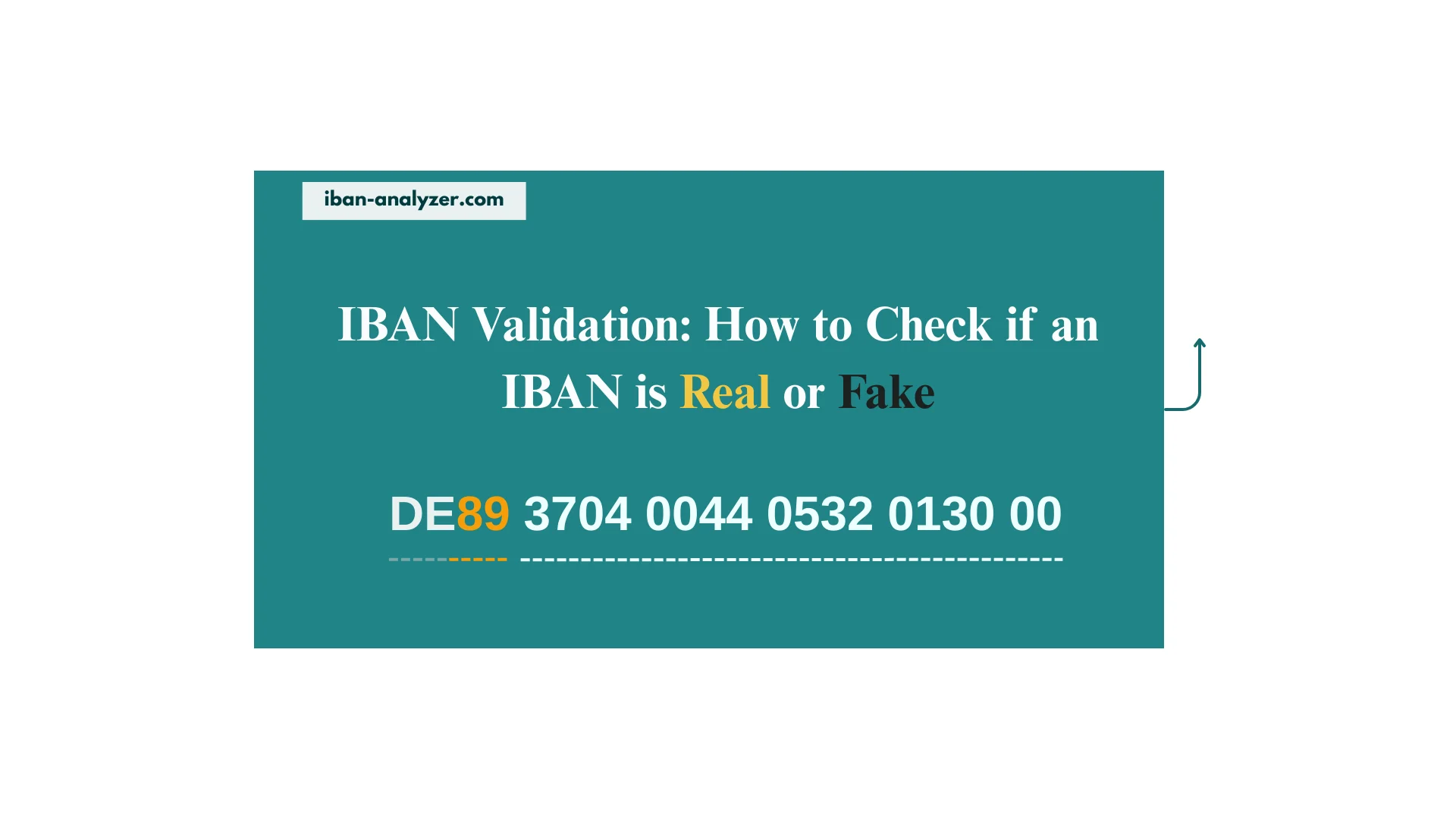
Here's what a typical German IBAN looks like:
DE89 3704 0044 0532 0130 00
If you want to try it out right now, paste this IBAN into IBAN Analyzer to see the full breakdown — country, bank name, SWIFT/BIC code, and validation result.
Breaking Down the IBAN Structure
Every IBAN follows a strict structure. Let's use our German example to walk through it:
| Part | Example | Meaning |
|---|---|---|
| Country code | DE | Two-letter ISO country code (Germany in this case) |
| Check digits | 89 | Two digits used to validate the entire IBAN mathematically |
| BBAN (bank account) | 3704 0044 0532 0130 00 | Country-specific bank and account details |
The BBAN portion varies by country. In Germany, the first 8 digits are the bank code (Bankleitzahl) and the remaining 10 are the account number. Other countries split it differently — you can explore the exact format for each country on our IBAN Countries page.
Important: IBAN length varies by country. Germany uses 22 characters, the UK uses 22, France uses 27, and Norway uses only 15. A wrong length for the stated country is one of the easiest ways to spot an invalid IBAN.
How IBAN Validation Works
IBAN validation is more than just counting characters. A proper validator runs several checks in sequence:
1. Country Code Check
The first two letters must be a valid ISO 3166-1 alpha-2 country code that participates in the IBAN system. If it starts with "XX" or "ZZ" — it's not a real IBAN.
Not sure which countries use IBANs? Check our complete list of IBAN countries for reference.
2. Length Verification
Each country has a fixed IBAN length. A German IBAN is always exactly 22 characters. A French one is always 27. If the length doesn't match the country, the IBAN is invalid — no further checks needed.
3. Check Digit Validation (MOD-97)
This is the most important check. The two digits after the country code aren't random — they're calculated using the MOD-97 algorithm defined in ISO 7064. Here's how it works:
- Move the first four characters (country code + check digits) to the end of the IBAN
- Replace each letter with a number: A=10, B=11, ... Z=35
- Divide the resulting large number by 97
- If the remainder is exactly 1, the IBAN is valid
This single check catches over 99% of transcription errors, including transposed or mistyped digits. It's the reason IBANs are so reliable.
4. Bank Code Lookup
A valid structure doesn't guarantee the bank actually exists. The final step is cross-referencing the bank code (BIC/SWIFT) embedded in the IBAN against known bank directories. You can use our Find Bank Information tool to look up any bank by its code and verify it's a real financial institution.
Common Signs of a Fake IBAN
Watch out for these red flags:
- Wrong length for the stated country
- Check digits fail MOD-97 validation
- Non-existent country code in the first two characters
- Special characters in unexpected positions — IBANs contain only letters and digits
- Bank code doesn't match any known financial institution
- Formatting that looks "off" — real IBANs are presented in groups of four characters separated by spaces
If any of these apply, don't send money to that IBAN without further verification.
How to Validate an IBAN in Seconds
The fastest way to check an IBAN is to paste it into IBAN Analyzer. You'll instantly get:
- Validation result — valid or invalid, with the specific reason if it fails
- Bank name and branch details
- SWIFT/BIC code — useful for wire transfers
- Country and IBAN format confirmation
Need to validate IBANs regularly or in bulk? Our IBAN Validation API lets you integrate the same checks directly into your application, with detailed documentation and flexible pricing plans.
If you work in a browser all day and frequently encounter IBANs, our browser extension lets you validate any IBAN with a right-click — no need to switch tabs.
Why Validation Matters
Sending money to an invalid or fake IBAN can result in:
- Delayed transfers — banks will reject the payment, but the process can take days before you're notified
- Lost funds — in rare cases, money sent to a valid but wrong IBAN may reach someone else's account, and recovery is not guaranteed
- Bank fees — failed international transfers often still incur charges on both the sending and receiving side
- Compliance issues — for businesses, repeatedly sending to invalid IBANs can trigger fraud alerts and compliance reviews
A five-second validation check can save you from all of this.
Conclusion
IBAN validation is a simple but critical step in any international payment. Understanding the structure — country code, check digits, and bank-specific account data — helps you catch errors and fakes before they turn into costly problems.
Before your next transfer:
- Paste the IBAN into IBAN Analyzer to verify it's valid
- Confirm the bank name matches what you expect
- Double-check the country code matches the recipient's location
It takes five seconds. Your money is worth it.